

Photo by Stephen Maturen/Getty Images
The Minnesota Vikings’ second-round pick, LB Jake Golday, has gotten to play a lot over the last two preseason games with the second team. In college at Cincinnati, Golday played a role that’s prevalent at that level but not in the NFL, playing outside the box and often blitzing from a very wide angle.
Golday was asked to operate in a ton of space in college (almost like a nickel defender), which helped showcase his gazelle-like speed to chase down the ball anywhere on the field. His mental processing took a clear jump in 2025, which was the hope during his second season as a full-time overhang linebacker. Though he had the explosive athleticism to get away with false steps in the Big 12, it won’t be that easy in the NFL. He is trending in the right direction against the pass, but his coverage recognition isn’t yet a strength. Overall, Golday is still unrefined in several areas, but his size, speed and ascending skill set are reasons to be encouraged. He projects as an immediate special teamer who can compete for defensive snaps during his rookie year.
He played in coverage and had some traditional LB reps as well, but it was generally recognized that he would need to adapt to the NFL game. As a player who is a lock to make the roster, Golday probably won’t play against the Denver Broncos in preseason week three, but he got extensive run against the New York Giants and Baltimore Ravens.
That tape will help us see how Golday is transitioning to the NFL game and what role the Vikings are actually asking him to play. Let’s dive in.
Table of Contents
Defining the Vikings’ Linebacker Roles
Because of his college role and Brian Flores’ unique scheme, Vikings fans generated quite a bit of discussion this offseason over the role Golday would play in the Vikings’ defense. Two players, Andrew Van Ginkel and Eric Wilson, were generally used as reference points for the roles. To define the archetypes a little bit, Van Ginkel is primarily an edge rusher who moonlights as an off-ball linebacker, while Wilson played last year as a linebacker, but often blitzed and saw some snaps lined up on the edge as well.
The full article is available for subscribers. Wide Left is a reader-supported publication. To receive new posts and support our work, consider becoming a free or paid subscriber.
As a prospect, Golday was pretty frequently compared to Van Ginkel, who really had very similar measurements and testing as a prospect, as well as the college flexibility to rush the passer and play coverage [Author’s note: and, let’s be honest, the comparisons also probably happened because they’re both white].
In terms of role on the Vikings, analysts like Arif, Luke, and Tyler Forness projected Golday to play more of a Wilson-esque role, primarily being an off-ball LB while still blitzing often and occasionally lining up on the edge. I personally expected Golday to be more of an understudy to Van Ginkel, and projected him as an edge rusher in my 53-man roster projection.
Watching the preseason games live, my impression was that Golday played off the ball against the Giants and more of an edge position against the Ravens. Going through the tape, it became clear that the Vikings asked Golday and fellow LB Chaz Chambliss to flip their roles between the two games, but against the Ravens, Golday reverted to his Week 1 role when Chambliss came off the field in Nickel packages.

Jake Golday’s alignment at the snap, per TruMedia
The tape helps define those roles, and we can start by looking at the Vikings’ first team defense. They only played three snaps together against the Giants, and Van Ginkel came off the field after the Giants got a first down. Still, those plays matched what the second team defense did.
On the play below, you can see a typical alignment for the Vikings. They have four players — Dallas Turner, Jalen Redmond, Levi Drake Rodriguez, and Tyrion Ingram-Dawkins, from left to right — with their hands in the dirt.
Further right of Ingram-Dawkins is Van Ginkel, who aligns towards the slot receiver initially but shuffles towards the line of scrimmage. Blake Cashman and Eric Wilson are off-ball LBs.
From the end zone angle, you can see the relative positions of the defenders. Turner is a 7-technique, outside the shoulder of the TE, Redmond is a three-technique, outside the shoulder of the right guard, Rodriguez is a one-technique, outside the shoulder of the center, and Ingram-Dawkins is a 4i, on the inside shoulder of the left tackle. If anything, Van Ginkel could be considered a Wide 9, way outside any blocker.
Really, though, this is what the below playbook, from Bill Belichick’s 1997 Jets defense, calls an “Over” front. Based on this diagram, Van Ginkel is the Will, Cashman is the Mike, and Wilson is the Sam.

As always, no playbook examples are clean, but this best approximates the point.
The way defenses set their “strength” can vary, particularly between the run and the pass. Typically, the “run strength” is to the TE, and the “passing strength” is where there are more receiving threats. Often they are the same side, but that’s not always the case.
If following that convention, the play above would have a run strength to the defense’s left and a passing strength to the right, because the TE and FB are offset to the defense’s left and there are two receivers right.
Usually you name the players based on the run strength, not the passing strength, so that’s why I’m calling Van Ginkel as Will on this play. The Vikings may be taking an alternate approach and setting the defense based on the ball location, but that’s immaterial at the moment.
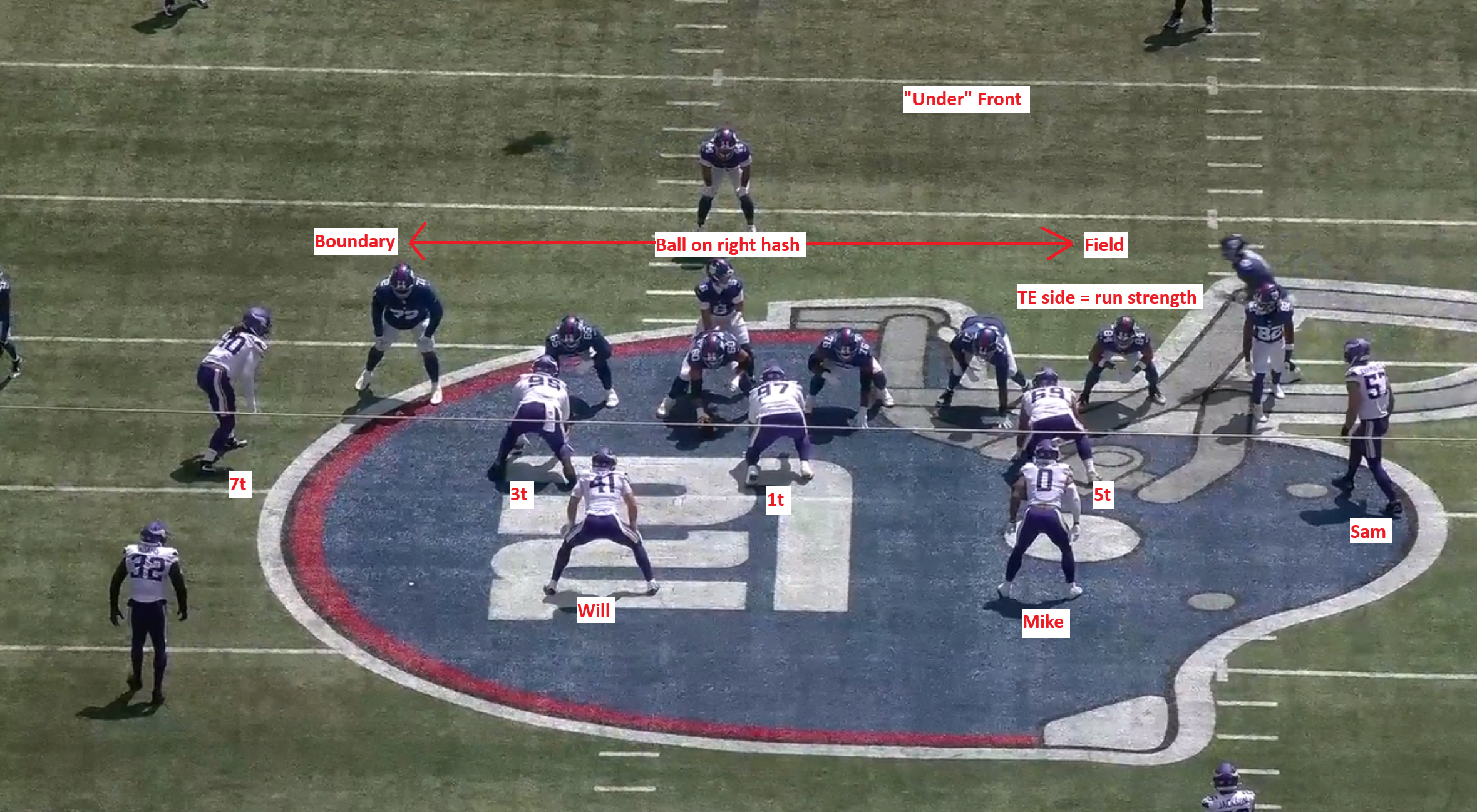
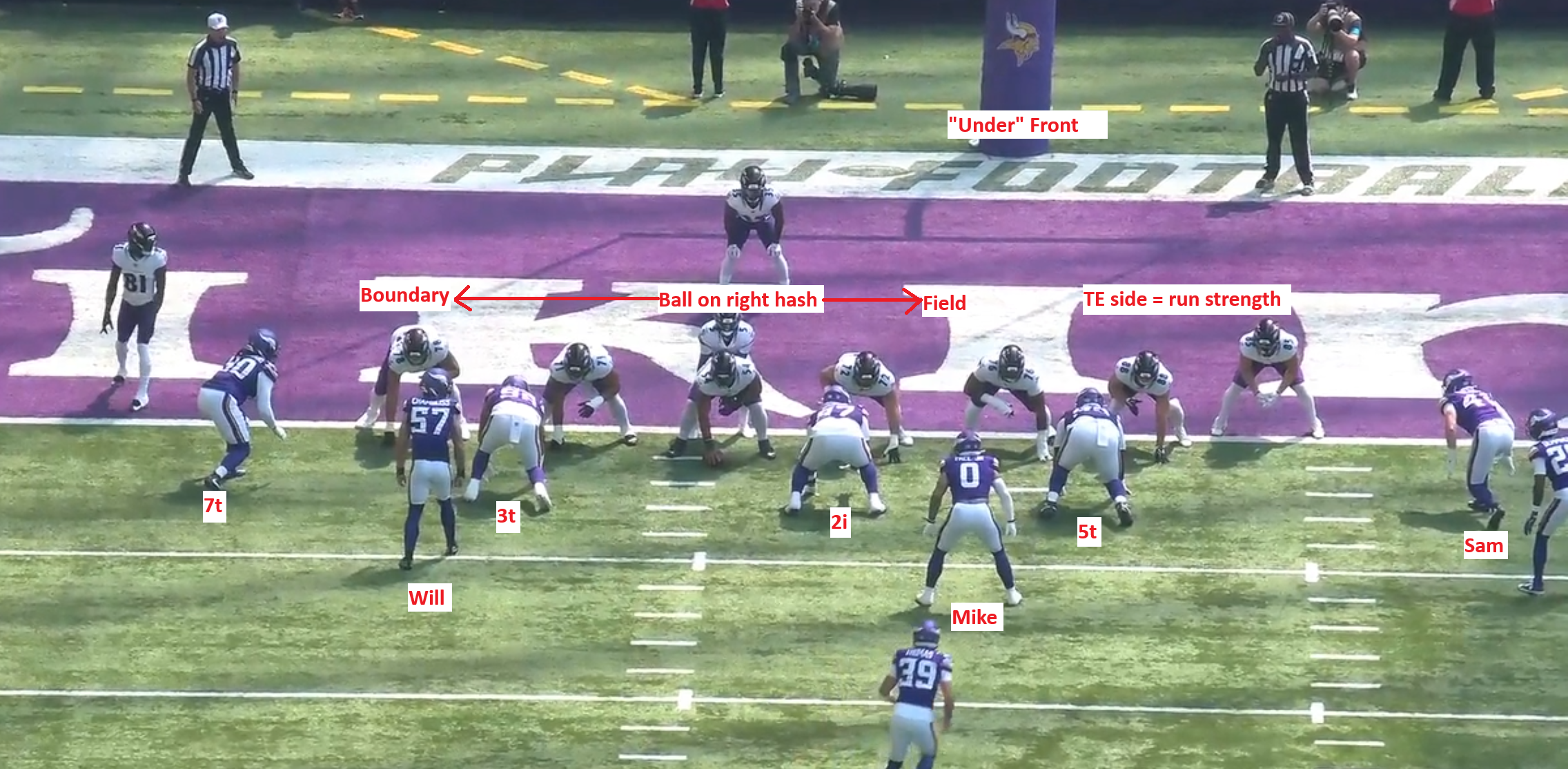
The next play shows a different offensive look, but a similar defensive look. This time, the Offense has the TE lined up to their left, but the Vikings players are in similar positions.
This time, they’re in an “Under” front, where Van Ginkel is the Sam and Wilson is the Will.

As mentioned before, the real key is to look at where the ball is. It’s on the right hash. That means that Van Ginkel is aligned to the “field” and Wilson is aligned to the “boundary.”
If you go through the Giants game, you can see that Golday is consistently lined up on the boundary side of the formation, off the ball (the “Wilson” role, an off-ball Will), while Chambliss is lined up on the ball to the field side (the “Van Ginkel” role, an on-ball Sam). In the Ravens game, those roles flipped, and Golday played on the ball to the field as a Sam, while Chambliss played off ball to the boundary as a Will.
As an aside, whenever Golday and Chambliss were on the ball, they had a defensive line body aligned at 4i or wider inside. This occupied the attention of the tackle, and meant that the players were truly playing an on-ball LB role, and not an edge rusher role. I think it would be inaccurate to say they had edge-rusher responsibilities.
The primary responsibility would be to take on TE blocks in run defense. In that position, there may be a few cases where they have to take on an OT block in run defense, but those would be few and far between, and I would not consider playing an off-ball LB in that spot a structural liability.
They’re not asked to be a true pass rusher from that spot. The Vikings are not really asking them, or Wilson for that matter, to play above their size in a rugged edge rusher role.
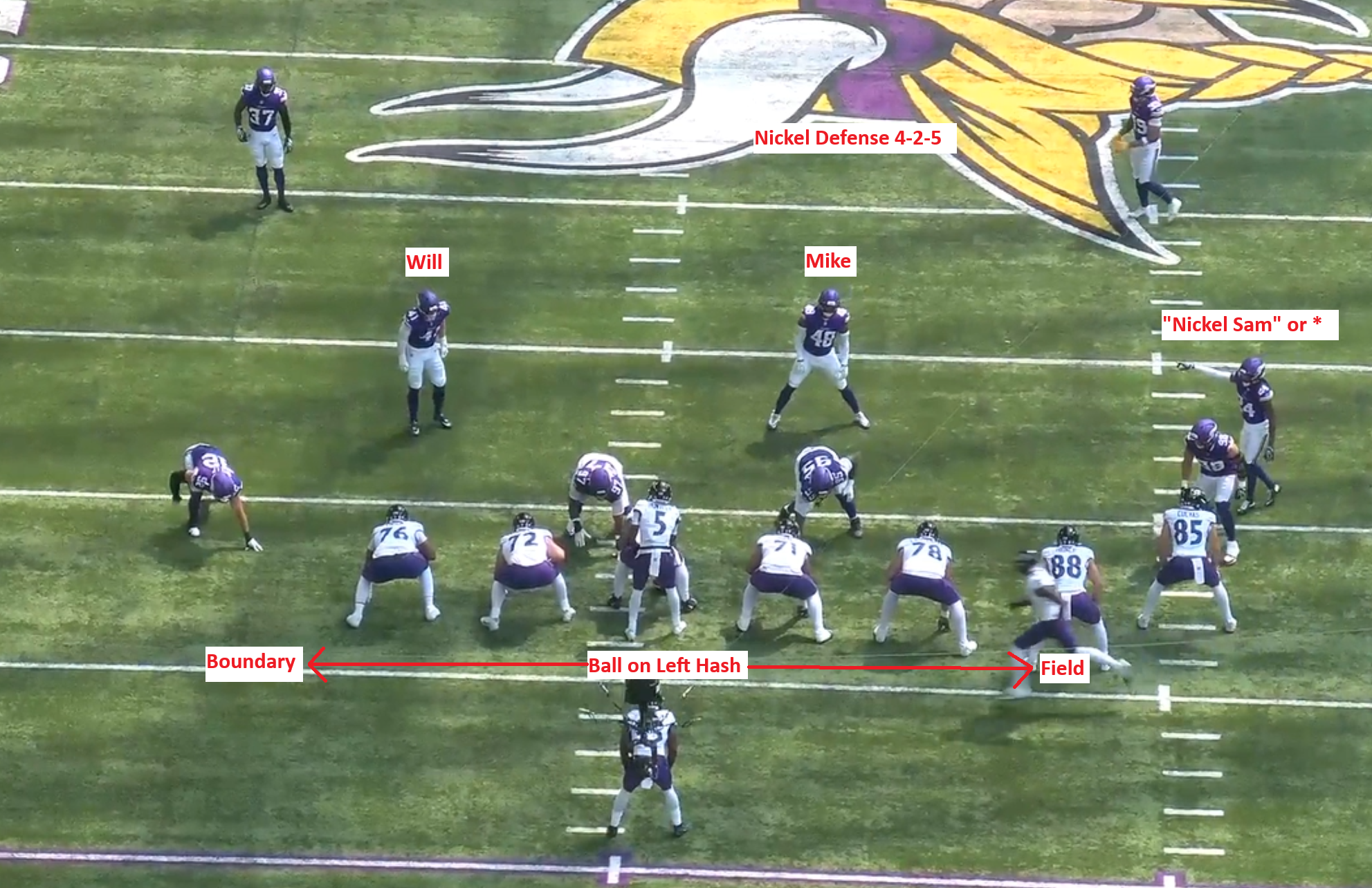
Notably, this trend also stuck when the Vikings played Nickel. On those plays, they typically ran a 4-2-5, and Golday aligned to the boundary consistently in both games. That made him the Will, with Ivan Pace Jr. (or Jacob Roberts) as the Mike, and left the Nickel player, primarily Jamal Adams or Jay Ward, as the Sam. “Nickel Sam” is a general term for how the defense treats the Nickel player, as that player is almost always aligned to the passing strength. Saban terminology calls this player the “Star,” denoted by an asterisk (*).
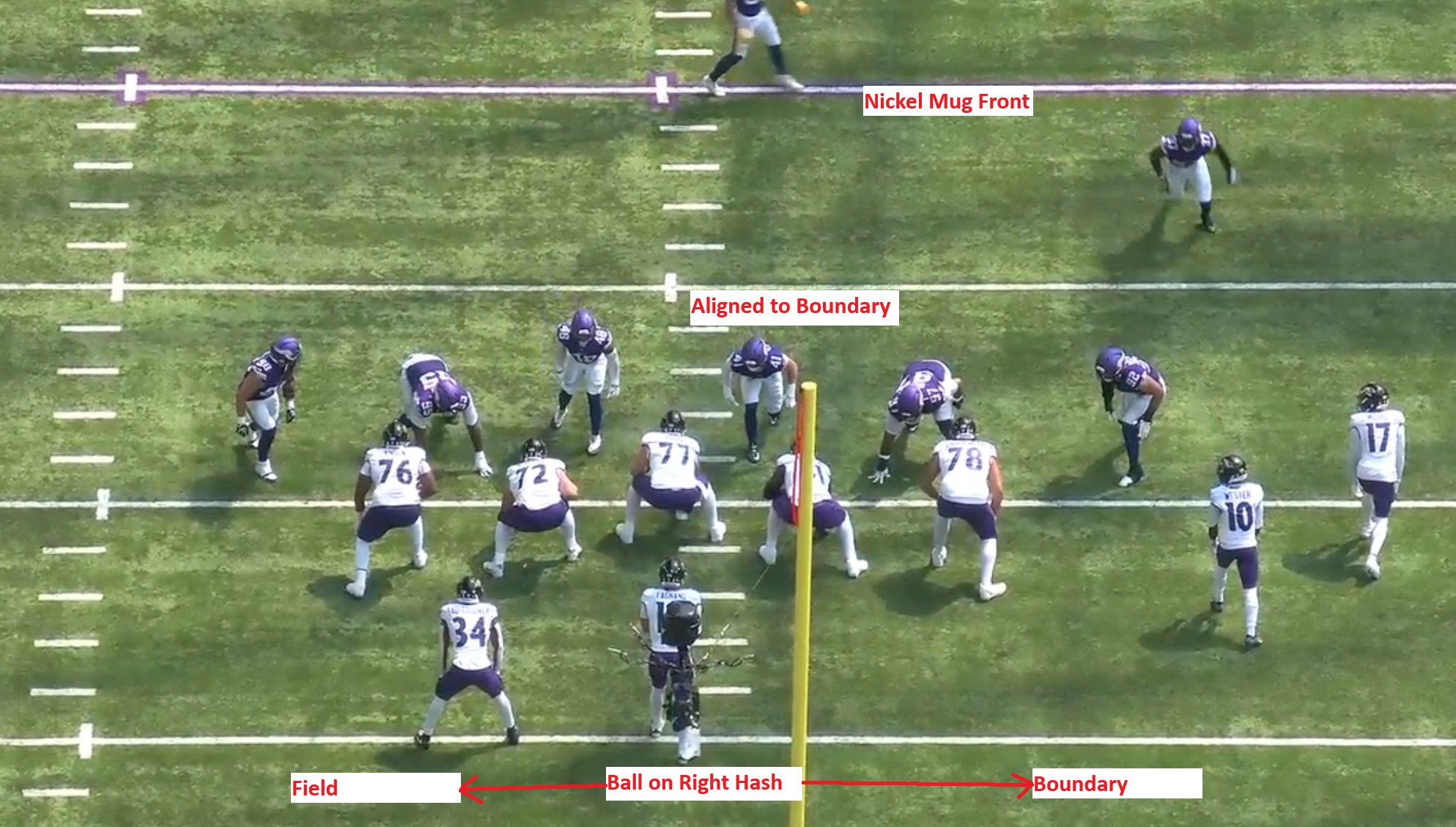
On the lone Nickel snap the Vikings’ first team defense played, you can see the Vikings align with a mug front, but Wilson is aligned to the boundary. In this case, Van Ginkel is aligned outside as a true edge (of course he actually drops into coverage), something the Vikings didn’t ask Golday or Chambliss to do. In these mug fronts, Golday was exclusively an inside linebacker like Wilson, and Chambliss was off the field, with Ingram-Dawkins on one side (usually the boundary, so replacing Turner in the play below) and Tyler Batty or Bo Richter on the other side (replacing Van Ginkel).
Here are the four primary ways Golday aligned.
Tap any image to view it full size.
With all of that said, the Vikings used Golday in both the Wilson and Van Ginkel role over the course of two preseason games, and they’re clearly preparing him to be versatile. But they used him much more in the Wilson role, so I would say we should consider him to be an understudy at off-ball LB, which is the opposite of what I expected.
Film Study
With his role fully defined, it’s time to dive into the tape on Golday. I think there’s a lot to be excited about.
Pass Coverage
When projecting Golday’s college tape to the NFL level, I generally thought he was a raw prospect. In particular, I thought he struggled in pass coverage. In the first two preseason games, however, he made several positive plays. There weren’t any particularly difficult assignments, but it was a nice step forward.
In zone coverage, Golday showed the ability to track routes in front of him and also follow the QB to the football. On the play below, the Giants throw a quick curl. At the snap, Golday widens towards tight end Theo Johnson, his responsibility in zone at that point, without overcommitting.
If he had overcommitted, he could have abandoned the space needed to cover the middle-of-the-field route from the opposite slot player. Instead, you can see him shuffle left with his eyes on quarterback Jameis Winston until his hands separate, before Golday transitions to driving on the throw. He’s able to quickly wrap and tackle Johnson for no gain after the catch.
This play against the Ravens produces a similar result. From the end zone angle, you can see Golday check the TE’s route, and then put his eyes back to the QB, mirroring Tyler Huntley as he scrambles. That brings Golday to the TE, and he’s in the area of the throw, ready to create a collision at the catch point.
Golday’s tracking of underneath routes also forced a turndown against the Ravens. Any time a QB has to progress in his reads, it creates extra time for the pass rush to get home and for something to go wrong. On this play, Golday is able to drive on the TE route, forcing the QB to go elsewhere with the ball, where Jacob Roberts has good coverage on a wide receiver and the ball is caught for a minimal gain.
This play featured another nice example of solid play in zone. You can see him check the No. 2 receiver going vertical, before moving towards the TE over the middle on a dig. When Huntley scrambles, Golday shows off his athleticism by coming up from his zone depth at the sticks and making a tackle, limiting Huntley to a gain of just 4 yards.
There was one man coverage rep I saw from Golday, the below play where he covers RB Cam Skattebo. It’s a flat route, which is about as simple as it gets, but it converts to a scramble drill. Golday is able to track Skattebo upfield and nicely turns in sync with Skattebo as he looks at the sideline. If QB Jaxson Dart had thrown the ball at Golday, Golday would have been able to deflect the throw.
Still, I’m not convinced Golday will be a stellar coverage player right away in the NFL. As I mentioned above, these were relatively simple coverage responsibilities, and Golday didn’t have to relate to many routes that were physically behind him, which I think is much more difficult to do. He also had a really bad rep against play action, below. On the play, he bites hard on the Ravens’ run fake, completely missing the TE who is crossing his face and running to the flat. This leads to a wide open catch and a gain of over 20 yards for a player that was Golday’s responsibility.
Ultimately, I think Golday will need more time to fully adjust to playing coverage in the NFL game. His preseason play has been very good, but at a low degree of difficulty. However, I am very encouraged that he already appears to have improved from his college play, and hope he can continue that trajectory into the regular season.
Run Defense
Similar to pass coverage, I had concerns about Golday as an off-ball run defender coming out of Cincinnati. Against the Giants and Ravens, he did a lot to alleviate my concerns. It wasn’t always perfect, but let’s dive into how he did.
First and foremost, I thought Golday lacked urgency when defending the run in college. This may have been because he was simply late to read the plays, but he would often be late to move towards the line of scrimmage at the snap.
Against the Giants, however, Golday set the tone on the very first play by firing forward, taking on a TE’s block, and reading the play in the backfield. The RB cut multiple gaps away from him, and Golday was able to disengage, surf over the gaps, and get in on the tackle. The play went for a decent gain because Banks and Orange both got blown off the ball a little, but Golday prevented it from being an even bigger one.
On the next play, you saw more aggression from Golday, this time against a right tackle, Jermaine Elumenor. Elumenor is a solid starter in the NFL, and Golday is able to pop him a little, lose limited ground (about a yard), and quickly shed the block to try to get after a run going away from him. The play is already blown up by Jamal Adams, but this is a really nice rep.
Golday is very much up for the fight in run defense, and not afraid to stick his nose in the fray. On the play below, he has to fit the run at the point of attack. He takes on a block from both a TE and a pulling guard. He does get knocked to the ground, but so do both of his opponents, creating a pileup. That’s a fine result for an off-ball LB against two blockers. Banks got crushed by a double team on this play, so there was a wide hole, and the RB actually hurdles over the pile, but it still created a big obstacle.
In the Ravens game, Golday was asked to play on the edge more often. We got to see multiple opportunities of him playing contain, and I thought the reps were pretty good. On the play below, he’s matched up against an LT. He is aggressive into contact, and doesn’t lose ground as he holds the edge. The blocker gets his feet knocked out from under him by Pace and falls down, so this rep might look a little more impressive than it actually is with Golday shedding the block, but it’s still a win for Golday.
Taking on an LT was nice, and Golday made taking on TEs look pretty simple. Ok, not as simple as Banks did on the play below, but on the edge Golday was still able to hold his ground and strain to knock the TE back a couple of steps before shedding the block.
The play below shows fruits for Golday’s labor as a contain player. Here, he takes on the TE into the backfield, as the RB tries to run to the edge. Because Golday is holding his spot down, the RB has to cut back into Tyler Batty and is tackled for no gain or a loss.
Even when it wasn’t perfect on the edge, Golday fought hard. The play below is a difficult assignment because he gets hit from a WR pinning him and then has to take on the TE. Golday loses a couple of steps, but at least stays on the outside shoulder, and forces the RB to round his path slightly as he runs to the edge. This give safety Jacob Thomas the time to fire down the alley and make a great TFL.
Golday also showed off his great athleticism multiple times as a run defender. On this play, the center is tasked with climbing to the second level and cutting Golday off. Golday reads the run, drives on it, and the C barely lays a hand on him. The rest of the defense has also done a good job, but Golday’s angle forced the cutback into three white jerseys.
The quickness allows Golday to win in space even without taking on blocks. On the play below, he sidesteps a TE, completely making him miss.
With all that being said, Golday was not perfect in run defense. Leverage and pad level were issues for him in college, and they continued to plague him in these two games. On the play below, he is a bit too passive for my liking. That may be the call, but I’d like to see him aggressively play forward against the double team that’s climbing to him. If he does, he might have caught the C off guard.
Instead, the blocker regains his balance and pops Golday back on initial contact. Golday is also playing with high pads on this play, which will cause him to lose ground against blocks. That was something I thought was a problem in college and might still need to be corrected.
Here’s another play where I think Golday plays with too high of a pad level. This time, he gets off the ball fine, but the RG, 10th overall pick Francis Mauigoa, creates massive displacement on first contact. On the play, Banks did a good job of fighting through a block (even if he lost ground) to make the tackle; otherwise the RB had a wide gap to run through that was vacated by Golday and would have only had to beat the safety for a massive play.
On this next play, Golday does a good job of coming forward, but loses leverage again, this time against Ravens LG Andrew Vorhees. Vorhees is able to move him back multiple steps and widen a hole for the RB to run through. It’s notable that both guards in the last two plays are big dudes, listed at 330+ lbs, but those are the types of blocks you have to take on in the NFL. Golday will need to work on his leverage.
I think there’s also an experience aspect to the play below. On it, Golday is asked to take on a cut block from the FB. As a great athlete, you would hope he could bounce off the block and keep his feet — or something close to it. Instead, he gets knocked completely flat to the ground because he doesn’t approach it correctly. He goes a little too low on approach. Ideally, Golday would get his hands on the blocker’s shoulders here, and help him to the ground while essentially leaping over the block. Pace makes a great tackle on the play, but Golday’s mistake could have led to a decent gain for the offense.
Golday is really athletic, and played aggressively against the run in a way that I thought was much improved from his college tape. He showed an understanding of his role and responsibilities in run defense, and I thought he did a good job of exploding into first contact, straining against blocks, and shedding, particularly when asked to contain. Still, he did get beaten a few times by stronger blockers when he played with poor leverage, something Golday will have to continue to clean up as he transitions to the pro game.
Pass Rushing
The most exciting thing about Golday joining the Vikings was visualizing him as a blitzer in Brian Flores’ defense. He, of course, had multiple opportunities to do so and showed well.
On this play, Golday and Pace are both mugging the A gaps and run a typical stunt for this kind of look. The C turns towards Pace, so Golday picks him and Pace loops around. Golday executes a nice pick, and the C is driven back multiple yards, giving Pace a wide space to beat the RB in pass protection. The ball is out quickly, but this is a very nice rush.
Here is a very similar rep, this time against an RG-and-C combo. Golday does a good job of letting the RG, 14th overall pick Vega Ioane, ride him into the C, creating space for Pace to loop around and get his hands on Huntley. Golday could have done a better job finishing the rep, as he slipped and fell to the ground trying to disengage from the pursuit, but he did his job really well on the play and helped create the scramble.
Elsewhere as a blitzer, Golday ran straight through the RB trying to block him on this rep:
Here, Golday was initially stood up a little, but drove the RB back into the QB’s lap, helping create an unstable throwing platform on a throw that also saw Orange drop into coverage, leading to an incompletion.
He also showed that knockback on the play below against an RB, but in this case he lost contain, allowing Huntley to get around him. You’d like to see him play the outside shoulder of the RB to prevent this, but Golday at least hustled, turning around to chase Huntley down and make the tackle for a limited gain.
Golday’s game probably needs more nuance as a rusher. Below, he’s coming forward and gets too much of a forward lean, allowing Daniel Fa’alele to easily throw him to the ground. The ball is out quickly on a screen.
Like other parts of his game, Golday needs some time to gain seasoning as a blitzer, but his aggression will help him make an impact right away in this role.
Tackling
I was really impressed with Golday’s tackling. He showed a great tackle radius across the two games.
On the play below, Golday is unblocked in the hole, but it’s very wide because both Domonique Orange and Caleb Banes got washed out. RB Eric Gray tries to set him up with a cut, but Golday is able to wrap Gray and bring him to the ground quickly for a limited gain.
The next play is a play action screen. Golday initially comes up to support against the run, then has to robot back when he recognizes play action, and then has to turn and chase the RB to the edge of the defense. That’s a difficult combo of movements, and in the end he’s able to drive, wrap the RB’s leg, and make a tackle to prevent a larger gain.
Later, the Ravens had a 3rd and 9, and Golday had a pretty typical zone drop, but had no real threats over the middle of the field, so there wasn’t much to do in coverage. The QB eventually scrambled, and Golday came up and once again made a tackle outside his frame, bringing the QB down after an 8-yard gain, short of the sticks.
I thought one more interesting play was the large screen gain the Vikings allowed to Giants running back Devin Singletary. Golday is the first defender near Singletary on the play, but I don’t think he’s responsible for the large gain at all. On the play, Golday has the opposing C climbing to try to block him.
He needs to drive the RB to his help, and he runs at Singletary’s outside shoulder, expecting Pace to be able to vice him. Pace overruns the play, and Singletary further cuts across to between Theo Jackson and James Pierre. Jackson should take the inside shoulder and Ward the outside shoulder, but Pierre also overruns the play and lets Singletary all the way to the outside for a huge gain. This was a bad play by the Vikings’ defense, but I don’t think it was Golday’s fault.
Overall, I thought Golday was very efficient as a tackler, showing a wide tackle radius and effectively bringing ball carriers to the ground.
Situational Responsibilities
The Vikings’ defense is different from what Golday is used to in Cincinnati, and he’s still adjusting to a few of the tasks they’re asking him to do. The plays below are somewhere between pass rushing and pass coverage, so I wanted to call them out as a small but significant area where Golday needs to improve.
The first area is what are referred to as “Tag” rushes. That’s when a defender initially steps forward as if he plans to pass rush and usually lays a hand on the offensive blocker, “tagging” him, before dropping back into coverage. This is critical for ensuring free runners on blitzes, as it makes the blocker commit to pass protect against a player who is actually dropping into coverage. The coverage drop is usually meant to take away “hot” routes that counteract the blitz. To my eyes, Golday played these tag rushes too aggressively and needs to improve his cadence to actually be effective in the coverage part.
On the first play below, Golday is lined up in the left A gap against the Giants. He comes forward, gets tangled up with the LG, and then ends up dropping back. The throw is quick, and he then starts chasing it. However, compare Golday’s rush to Pace next to him. You can see Pace pump his arms once before putting his hands up to feign initiating contact and dropping back. He’s well clear of the LOS before Golday steps back. The LG did play this more aggressively than the C did, but Golday needs to transition more quickly and not get caught up.
This also happened in the Ravens game, this time with Golday off the left edge. This is a challenging rep as he gets chipped but still has to come forward to tag the other TE who is pass protecting. You can see that player has a “dual,” reading inside out to block either Golday or Zemaiah Vaughn who is actually blitzing off the edge. Once Golday steps forward from the chip, he gets the TE to commit. At that point, he should put up his hands and fall back. Instead, he takes another full step forward to contact the blocker, and by the time he’s turned around the QB has already thrown the ball. The chip hurts, but this timing is simply way too slow; Golday would have never impacted a hot route with this drop.
The other situation I think Golday needs to master is normal zone drops from a mug formation. He wasn’t asked to play in these situations in college so it makes sense that he’s still learning, but understanding his role will prevent busts. On the play below, you can see that all of Golday, Pace, and Ward drop out from the line of scrimmage, and the Vikings are running a Cover 2 look with two deep zones and five underneath zones. Those zones should be spread out roughly equally. Ward drops straight back, between the numbers and the hash, and has James Pierre well spaced outside of him. Pace angles to the right hash, but Golday angles towards where Ward is. He should instead be angling straight back, to ensure an evenly spaced zone. Ultimately, his responsibility on this play would be to pick up the RB leaking out of the backfield.
I would consider these rookie growing pains, and hopefully Golday can clean them up as he gets more comfortable in the defense. The Vikings are asking him to play from a variety of different angles, and I’m sure there’s some information overload. Experience should help him resolve these issues.
Final Results
We’ve learned that while he split time between the Andrew Van Ginkel and Eric Wilson roles, Jake Golday was asked to play more like Wilson in an off-ball position over the Vikings’ first two preseason games. In that role, there was a lot to like.
First, as a coverage player, Golday was generally sound, relating to underneath routes efficiently and making several positive plays. He demonstrated the fluidity to stick with opponents in man coverage.
There are still concerns, including a bad rep where he bit hard on a play action, and he can struggle to get into his drops from the line of scrimmage on tag pressures. He also didn’t have too many reps on film that required more difficult coverage processing, but the plays he did have were an encouraging step forward from his college tape.
As a run defender, Golday showed aggression that may indicate a coaching difference between college and the NFL. He did a really good job of setting an edge when asked to play on the line of scrimmage and disengaged from blocks efficiently on several really nice reps.
His athleticism also allowed him to beat opponents to spots on multiple occasions, and he played in the right position in the Vikings’ run fits. He still has to improve his leverage against stronger blockers, and allowed a few lanes because he lost ground to blocks, but, like in pass coverage, overall his tape was much improved from his college play.
I think Golday can potentially make a quick impact as a blitzer. He was forceful, both acting as a pick player and taking on RBs as a pass rusher. I also think Golday clearly has the athletic ability to effectively wreak havoc as a looper and showed the fluidity in college to corner around the edge when asked to. He might need technical improvements in order to take on blocks from offensive linemen, but I don’t think the Vikings are going to ask him to do that early on.
Finally, Golday really impressed me as a tackler in these two games. I thought he made a number of difficult tackles on relatively open areas, showing a wide radius to get ball carriers down and the athleticism to make late adjustments as his opponents tried to cut.
I don’t know if Golday will be able to consistently crack the Vikings’ lineup early on with the players that are in front of him. If he does, there will be some growing pains as he learns some of the technical details of the position, but his attitude and physical ability will also allow him to make splash plays that should make up for those faults as a young player who is continuing to grow.
