

Photo by David Berding/Getty Images
As the team was reporting to training camp, the Minnesota Vikings signed RT Brian O’Neill to a contract extension. It was an expected move, one that had been mentioned by beat writers when discussing the Vikings’ offseason. In analyzing their limited spending in free agency, ESPN’s Kevin Seifert mentioned that the team was “budgeting” for extensions for both O’Neill and WR Jordan Addison.
Focus was renewed on a potential Addison extension less than a week later when Baltimore Ravens WR Zay Flowers signed a large extension. Flowers was selected just one spot before Addison in the 2023 NFL Draft, and is a natural comparison point for Addison.
Will Flowers’ contract extension affect what Addison gets paid? And just how does one go about projecting a contract anyway? Here’s my process and projection.
[Author’s Note: All cap and contract data is from OverTheCap.com]
Table of Contents
Finding A Price Range
How NFL Players are Valued
In the NFL, both teams and agents generally negotiate contracts based on precedent. Obviously, agents want the most money for their client and teams want the best possible deal, but both sides primarily use precedent to produce a reasonable compromise and finalize the contract. We see this on a constant basis when new deals are announced throughout the league.
It’s easiest to find this use of precedent at the top of positional markets. Recent running back deals are great examples of this. Bijan Robinson recently signed a 3-year, $66.75 million extension with the Atlanta Falcons, or $22.25 million average per year (APY).
This beat out Saquon Barkley, who had signed an extension with a $20.6 million APY in 2025. If you adjust for the cap environment, the values are almost identical. Bijan’s APY comes out to 7.39% of the $301.2 million salary cap in 2026, while Saquon’s contract was for 7.38% of the $279.2 million cap in 2025.
Very shortly after Bijan signed, the Detroit Lions announced that they had come to terms with their star RB, Jahmyr Gibbs. That provides another lesson; Gibbs got $67.5 million over a three-year extension, or exactly $250k more per year than Bijan. Bijan and Gibbs both have legitimate claims to be the best RB in the NFL, but agents push for each new contract to beat the last one, so Gibbs got rewarded because he signed second.
Justin Jefferson’s contract is another example of this. In 2024, Jefferson signed an extension for $35 million APY, the highest in NFL history for a non-quarterback. That extension beat out the San Francisco 49ers’ Nick Bosa, who had signed for $34 million APY in 2023. That price tag didn’t quite rise with cap inflation, but the league also values edge rushers slightly more than it does receivers, and the outcome reflects that difference.
For players at the top of the market, it’s relatively simple to just extrapolate what the last guy got paid, and use that as a projection. For players below the top, that can also work, but you need to find an appropriate comparison point.
Left tackle Christian Darrisaw, who also signed an extension with the Vikings in 2024, received a deal worth $26 million APY. He signed in the same season that Penei Sewell, also drafted in 2021, signed an extension with the Lions for $28 million APY. At that point, while they were both considered high-level offensive tackles, Sewell was a 2x Pro Bowler and had just made First-Team All-Pro, and Darrisaw lacked any postseason accolades.
However, there was a top-of-market tackle that ended up being a good comparison for Darrisaw. Andrew Thomas signed a $23.5 million APY deal in 2023, entering his 4th season. Thomas had never (and, like Darrisaw, still hasn’t) made a Pro Bowl. He did have a Second-Team All-Pro nod in 2022, but that didn’t seem to affect negotiations. If you calibrated Thomas’ contract to the 2024 cap environment, you got a bit over $26 million APY, which is exactly what Darrisaw got.
Many readers don’t realize that they aren’t logged in or aren’t reading the full story! Only paying subscribers (including those on a free trial) have access to the full written content on Wide Left. Make sure you’re logged in or subscribed if you want to access everything we’ve written.
Wide Left is a reader-supported publication. To receive new posts and support our work, consider becoming a free or paid subscriber.
The Vikings’ most recent contract for O’Neill reinforces this precedent. While O’Neill wasn’t at the top of the OT market, there were clearly comparable contracts. The Falcons’ Jake Matthews, the Raiders’ Kolton Miller, the Panthers’ Taylor Moton, and the Packers’ Zach Bako-Bewele (formerly Zach Tom) all signed extensions in 2025 for between $22 and $22.5 million APY.
If you adjust those deals for cap inflation, it comes out to between $23.7 and $24.3 million, which Brian O’Neill’s $24 million APY is right in the middle of.
Honing in on Addison’s Tier
So, the first key for us in projecting Addison’s contract will be finding the right player, or group of players, to compare him to. Given their draft proximity, is Flowers that player?
I don’t think so.
Flowers caught 86 passes for 1,211 yards last year, 7th in the NFL, and made his second consecutive Pro Bowl. Flowers has two consecutive 1,000-yard seasons, and 3,128 career receiving yards (11th in the NFL over that span) to Addison’s zero 1,000-yard seasons and 2,396 yards (33rd in the NFL).
From a film study perspective, that comparison probably isn’t fair to Addison. Besides the fact that he plays alongside Jefferson, an elite receiver, a neutral analyst’s ranking of the two players would almost certainly place them closer together than 11th and 33rd. However, historically that hasn’t actually mattered too much for contract negotiations. Instead, it’s more about the player’s status in the NFL, and a little bit about where they are in their team cycle.
Zay Flowers is the clear No. 1 option with the Ravens. That gives him a certain status, and while he did not get paid like an “Elite Receiver” (Jaxon Smith-Njigba, also drafted in 2023, set that standard this offseason with a $42.15 million APY), he did get paid just one tier below that, as a “True No. 1.”

For me, the “Elite Receiver” tier is currently just four players, with different APYs based on when they signed their deals — JSN (2026), Ja’Marr Chase ($40.25 million APY in 2025), Jefferson (listed above), and CeeDee Lamb ($34 million APY in 2024).
The “True No. 1” receiver tier has a few more players. Flowers is now in it, along with Drake London ($35.26 million, signed in 2026), DK Metcalf (nearly $33 million APY, signed in 2025), Garrett Wilson ($32.5 million APY, signed in 2025), AJ Brown ($32 million APY, signed in 2024), Brandon Aiyuk ($30 million APY, signed in 2024), and Amon-Ra St. Brown ($30 million, signed in 2024) all occupy this tier.
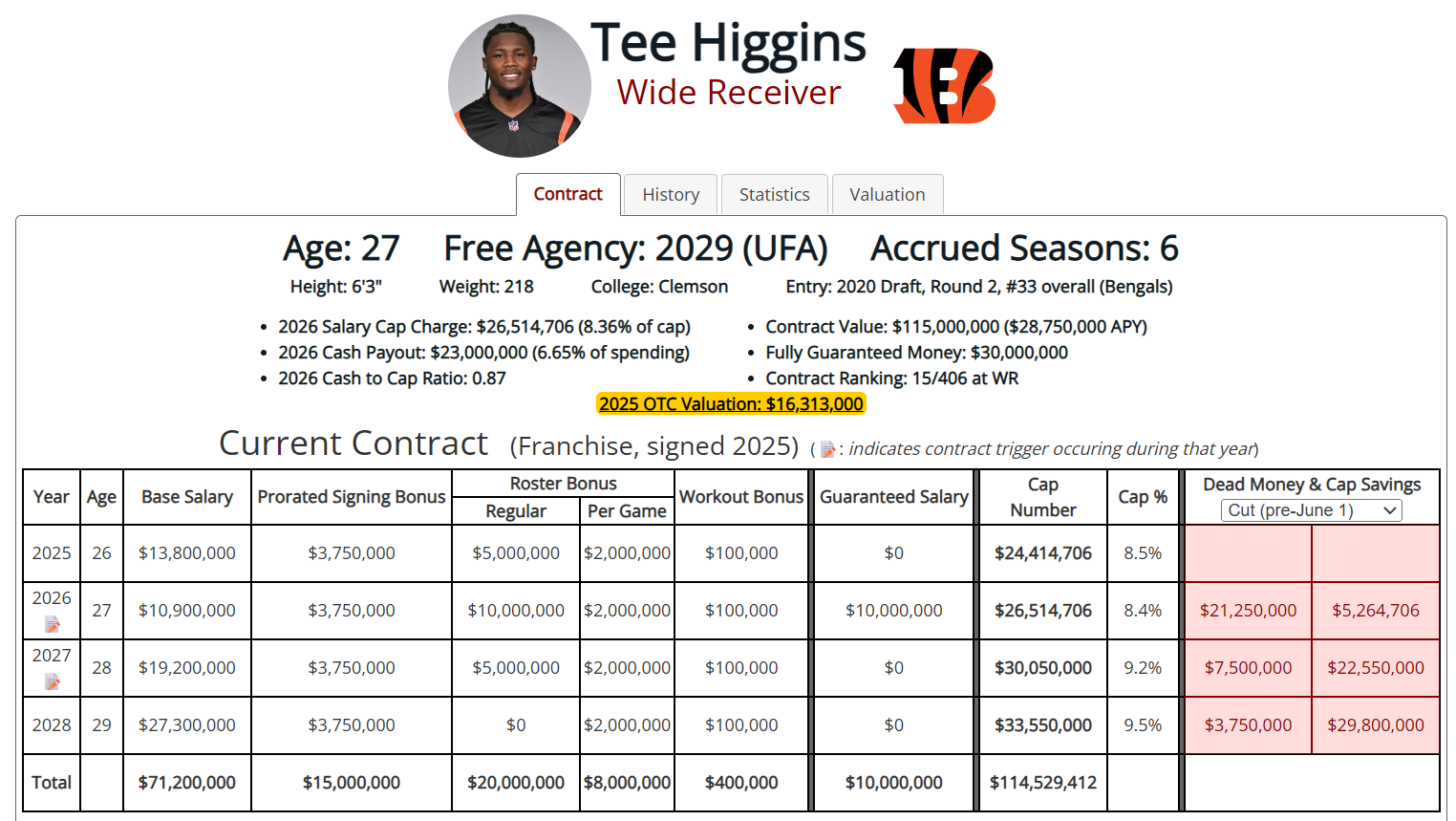
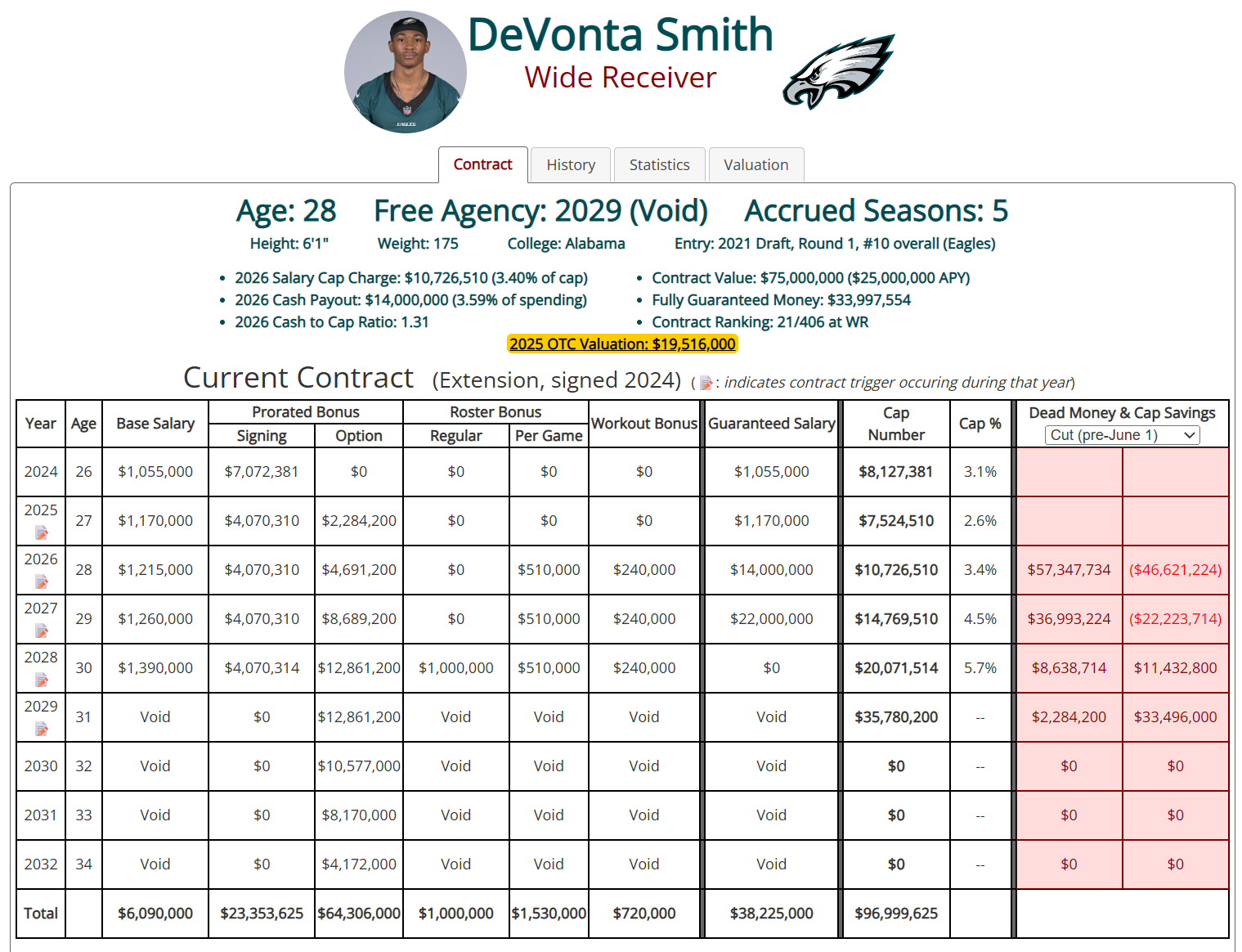
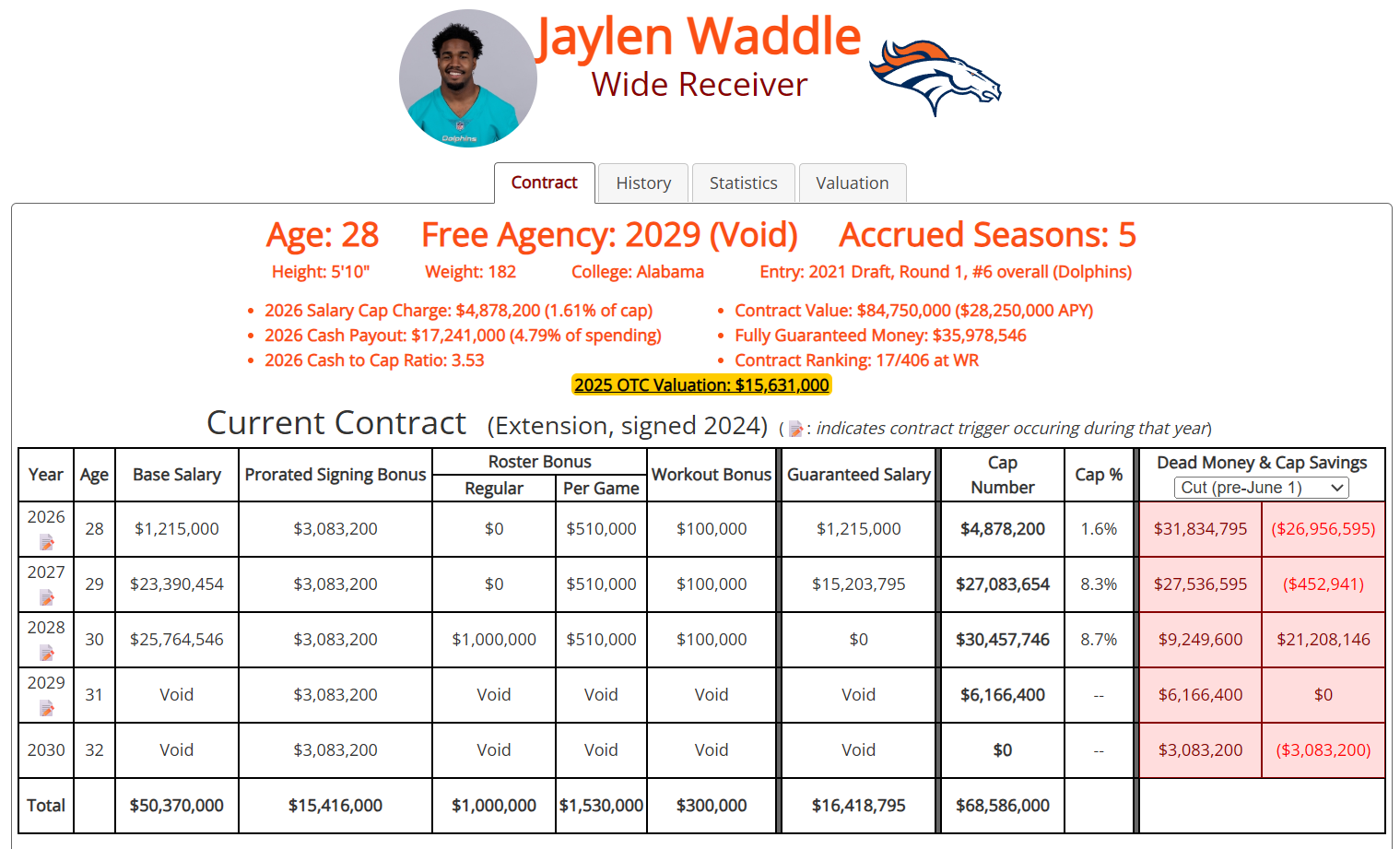
After that group is where I believe Addison’s contract should fall. You can find a pretty neat tier of “High-End No. 2 Receivers” with Tee Higgins ($28.75 million, signed in 2025), Jaylen Waddle ($28.25 million, signed in 2024), and DeVonta Smith ($25 million, signed in 2024).
At the time each player signed their deal, they each played alongside a better receiver who earned more (Chase for Higgins, Tyreek Hill for Waddle, and Brown for Smith). Combined, these players have one Pro Bowl invitation.
It’s worth noting that all three “High-End No. 2” receivers had significantly more receiving production than Addison has had; all had multiple 1,000-yard seasons by the time they were extended, but narratively they fit the description.
However, in this projection the Vikings are extending Addison early, a move that would signal they view him in that category. Lower-cost extensions include players like Jameson Williams ($26.7 million APY in 2025) and Christian Watson ($23 million APY in 2026), who were significantly less reliably “proven” players, much more risky propositions. Addison fits more with the former group than the latter.
Projecting an APY
Now that we’ve established Waddle, Smith, and Higgins as the comparison points, we can try to hone in on a contract value for Addison. On the low end, if we project Smith’s contract out to the 2026 cap environment, it’s roughly $29.5 million APY. On the high end, Waddle’s contract projects to $33.3 million APY. Higgins is conveniently in the middle, at $31 million APY.
It’s tempting to just project Addison at $31 million APY and call it a day, but there’s a catch with Higgins’ contract. Higgins was on the franchise tag when he signed, which means his contract went into effect immediately. Waddle and Smith, plus Addison in this scenario, each signed after just three years in the NFL.
Each had his respective 5th year option picked up, which means that their three year extensions were tacked on to the end of their deal rather than going into effect immediately. Instead, Waddle and Smith are just entering the extended parts of their contracts in the 2026 season. Addison, if he’s re-signed, won’t reach that point until 2028.
Tap any image to view it full size.
Obviously, the players receive more money up front — cash that flows immediately into their bank accounts — when they sign extensions, but the extensions lower the early-year cap hits for when the extension kicks in. That fact also changes the math of how the contract should be considered.
The best example of this is A.J. Brown. When he signed his extension in 2024, he was already signed through the 2026 season. The new years on his deal won’t kick in until 2027. That offseason, at edge, Brian Burns and Josh Hines-Allen were also extended, but both signed contracts while on the franchise tag.
That meant that their contracts kicked in immediately. Burns got $28.2 million APY and Hines-Allen got $28.25 million APY. It may look like Brown’s contract easily outpaced both at $32 million, but remember that the money on Brown’s deal doesn’t really kick in until 2027.

Subscribe to read the rest. Start with a Free Trial.
Start a 7-day free trial before becoming a paying subscriber to access this post and other subscriber-only content.
Free TrialA subscription gets you:
- Access to All Subscriber-Only Posts
- Ability to Comment On Posts